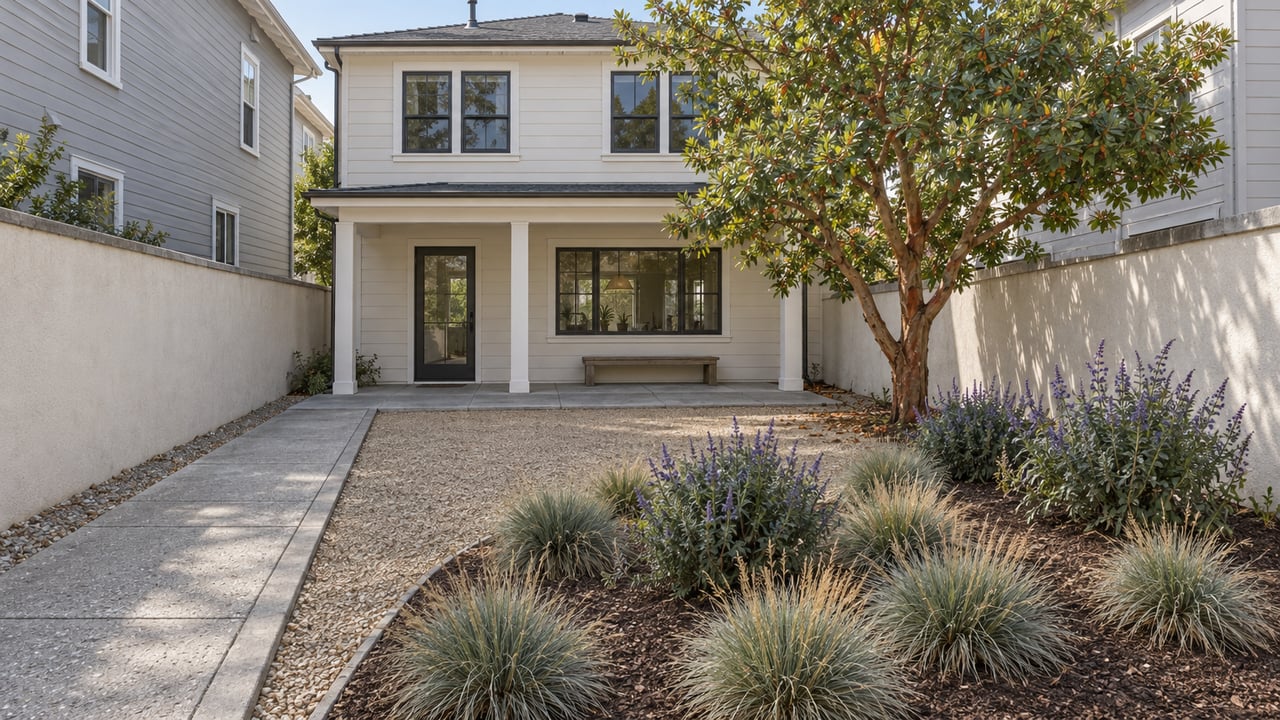
The house at 5150 Shafter Avenue isn't going anywhere, and neither is its ADU. The change is behind them. According to SF YIMBY's October 7, 2026 report, the property's private owners filed a zoning worksheet to divide the extended rear yard into four new parcels, each planned for its own new single-family home. Oakland's Baran Studio is designing the homes, and SF YIMBY reported that the layout would loosely follow the adjacent property at 5120 Shafter Avenue.
This is the site's second attempt. In July 2025, SF YIMBY covered a pre-application for four rear-yard homes on the same lot, and that one named the Richmond nonprofit TentMakers Inc. as the applicant. Fifteen months later, the owners are sponsoring it themselves.
This post focuses on what the filing shows about property value. On Temescal blocks zoned for more than one home, lot depth can now be divided into separate home sites under a state law that lets the city do little more than check boxes. Two lots with the same square footage, one in the flats and one in the hills, can now carry very different development potential. Listing prices don't always show that.
What the law lets an owner do with a backyard
The reports on the Shafter filing don't name the law it will use, but a multi-parcel split behind an existing house is the kind of project allowed by California Government Code section 66499.41, the small-lot subdivision statute created by SB 684 and expanded by SB 1123. It allows one lot to be divided into as many as 10 parcels holding as many as 10 homes. The new homes must average no more than 1,750 net habitable square feet. That cap is an average across the project, not a limit on each house.
The approval process is what sets this law apart from older subdivision rules. The city reviews the map ministerially, with no discretionary review and no hearing. It must approve or deny a complete application within 60 days, or the application is deemed approved. To deny it, the city needs a written finding of a specific, adverse impact on public health or safety that can't be feasibly mitigated.
Oakland has built this into its standard intake. The city's streamlined-review page lists SB 684 as a ministerial project type and points applicants to a zoning worksheet, a basic development application and an SB 684 supplemental application. A zoning worksheet, the first item on that list, is what the Shafter owners filed this month. The 60-day clock starts only once the city has a completed application.
Why zoning matters more than lot size
Oakland's SB 684 supplemental application is where the split between the flats and the hills shows up. The checklist sets two different tests depending on how the lot is zoned.
| Requirement | Lot in a zone that allows two or more homes | Lot in RH-1, RH-2 or RH-3, one-family only |
|---|---|---|
| Existing house on the lot | Allowed to stay | Lot must have no permanent structures, or only abandoned and uninhabitable ones |
| Largest eligible existing lot | 5 acres | 1.5 acres |
| Smallest new parcel | 600 square feet | 1,200 square feet |
| Maximum outcome | 10 parcels, 10 homes | 10 parcels, 10 homes |
The first row is the one that affects value. On a one-family hill lot, a family living in the house can't use this tool, because the lot only qualifies if it's vacant. On a lot zoned for two or more homes, the house can stay where it is while the backyard becomes new parcels. That's the arrangement 5150 Shafter proposes.
Among Oakland's zones that allow more than one home are the RM districts. The Oakland Planning Code calls these "Mixed Housing Type Residential" zones, meant for areas with a mix of single-family homes, townhouses and small multi-unit buildings. RM-2 specifically covers homes, duplexes, townhouses and small multi-unit buildings. Zoning still varies block by block, so check the exact designation of any parcel using the address lookup on the city's zoning map page.
Shafter shows the pattern well. Hoodline's coverage describes it as a city-designated Bicycle Boulevard linking Temescal to Rockridge, two blocks from Telegraph Avenue. Hoodline also reported that another nearby parcel on the block already holds a duplex with two detached rear cottages. Deep lots with more than one building on them aren't new here. Ministerial subdivision is new, and it can turn that extra land into separately titled home sites.
The catches that show up in escrow, not on the listing
Being eligible for a split doesn't mean the new lots can be sold right away, and the gap between those two things matters to buyers and sellers.
Three conditions in the statute and Oakland's checklist change what a split is worth in practice:
- The existing homes stay together. A subdivision under this law can't make any existing dwelling saleable apart from the title to the other existing dwellings on the lot. At 5150 Shafter, that means the house and its ADU remain one unit for sale.
- New parcels can't be sold or financed while empty. Under amendments made by AB 130 in 2025, a resulting parcel generally can't be sold, leased or financed separately until it holds a code-compliant residence, with a few exceptions such as common areas or the last remaining undeveloped parcel. A local ordinance or map condition can waive this. In practice, an owner has to finance and build before selling any new lot.
- No ADUs on the new parcels in Oakland. Oakland's checklist asks applicants to acknowledge that no ADU or junior ADU will be allowed on parcels created through this process, "now or in the future."
All three conditions push toward the same kind of owner: someone who can carry construction costs, or who partners with a builder, before a lot produces any sale. The Shafter filing hasn't said which route its owners plan to take. Hoodline reported that the owners haven't said whether they'll sell the new parcels individually or hold them as rentals.
Oakland projects that have already filed
The city's ministerial projects log shows what these filings look like elsewhere in Oakland:
- 3261 Hollis, filed January 14, 2025: three rear townhouses with two units each, a four-mini-lot subdivision under SB 684, and two existing front units left unchanged. The applicant listed is from Baran Studio, the same firm designing 5150 Shafter.
- 217 Monte Vista Avenue, filed June 6, 2025: a split of a 5,640-square-foot parcel with an existing triplex, adding a new 1,382-square-foot, three-bedroom house on a resulting 1,857-square-foot parcel.
- 1083 55th Street, filed June 13, 2025: a parcel map on an RM-2 lot where the duplex stays as it is and a detached accessory structure becomes a separate third unit on its own new lot.
Each of these keeps existing housing in place and adds homes on land the original layout left unused. Shafter is a larger version of the same idea.
The rules change for applications received after January 1
The current rules have an end date for new applications. SB 1090 was signed on September 30, 2026 as Chapter 1006 of the 2026 statutes. It amends section 66499.41, and its amendments apply only to applications a city receives on or after January 1, 2027.
The chaptered text includes these changes:
- Lot-size averaging. On multifamily-zoned land, a new parcel can be as small as 480 square feet if the new parcels average 600 square feet or more. No new residential parcel can exceed half the size of the original lot when averaging is used.
- A base-zoning ceiling. The site's base zoning can't allow more than 15 units, or, where zoning sets no unit maximum, more than 26,250 square feet of residential floor area.
- Unchanged limits. The 10-parcel and 10-home caps remain, and so does the 1,750-square-foot average. The unit-size definition now also excludes stairs and enclosed bicycle parking.
When this post goes live, roughly two months remain before that date. For an owner weighing a split, which set of rules applies depends on when the application reaches the city. Readers should check the final operative text with the city and a land-use attorney, because SB 1090 includes versions that interact with other 2026 housing bills.
What this means if you're buying or selling a deep lot
The broader market leaves little time to research zoning after an offer is made. In September 2026, the California Association of Realtors reported a median sale price of $1,265,000 for Alameda County single-family detached homes, a median of 13 days on market, and 2.2 months of unsold inventory. When homes sell that fast, a lot's zoning and depth are worth knowing before the first showing.
For a seller, a deep Temescal lot on a block zoned for two or more homes has something to show buyers that a comparable house with a shallow yard doesn't. The listing can present that potential accurately with the zoning designation, the lot dimensions and the existing improvements. The construction and financing conditions above should be stated just as clearly. For a buyer comparing a flatland Temescal house with a similar-sized home in a one-family hill zone, the zoning row in the table above may matter more than the price per square foot.
Everything above is general information about how these rules are written, not legal, tax or financial advice. Confirm how they apply to a specific parcel with the City of Oakland and a qualified land-use attorney.
A few direct questions
Is 5150 Shafter approved? No. The filing is a zoning worksheet, and final design plans haven't been released.
Is this the same as an SB 9 lot split? It doesn't appear to be. Hoodline notes that SB 9 divides a qualifying single-family parcel into two lots, while the Shafter filing describes four new parcels. The statute also lets a city decline an SB 9 split on a parcel created under section 66499.41.
Can I keep my ADU and still split the lot? Under Oakland's checklist, existing dwellings can't be made saleable apart from one another, and created parcels can't get new ADUs. At 5150 Shafter, the existing ADU stays with the main house.
If you own a deep lot in Temescal and want to know what its zoning, depth and condition mean for your sale, East Bay Home Transitions can review the parcel with you and bring in our construction team on what pre-sale work is worth doing. Start Your Transition: Request a Free Home Valuation & Renovation Plan.