Walk east from the Seaplane Lagoon Ferry Terminal and you pass some of the best-located dirt on the island. It fronts the water. It's a five-minute walk from a ferry that reaches San Francisco in under twenty-five minutes. And it sits empty, fenced, contributing nothing to the neighborhood around it.
That block can't be sold. It's classified as state tidelands, a legal designation left over from how the old Naval Air Station was carved up when the base closed. Tidelands can't be transferred to private ownership, so this particular stretch of prime Alameda Point waterfront will never generate a dollar toward the roads, sewers, and parks the rest of the redevelopment needs. It's a small detail. It also explains something that shows up in this year's sales numbers and surprises almost every buyer who tours both sides of the island: Alameda's new construction is moving slower, and for less per square foot, than its Victorians.
The pay-for-itself promise is behind schedule
Alameda Point was supposed to fund its own reconstruction. The city would lease or sell off former Navy buildings and vacant parcels, and that revenue would pay for the streets, utilities, levees, and stormwater basins the base actually needs before more housing can go in. On January 20, 2026, the City Council held a workshop to admit that math isn't working the way it was supposed to.
The numbers from that workshop's staff report are direct. The total cost to complete the Alameda Point Master Infrastructure Plan has climbed from $700 million in 2020 to $840 million in 2025, a 20 percent jump driven by construction, labor, and material costs. Over that same stretch, only five buildings at Alameda Point have actually sold, generating about $31 million, money that's already been spent upgrading street infrastructure. The staff report put it plainly: costs have escalated while land and building values have not kept pace.
The city has been trying to correct course since. Phase 1 of the reuse area's infrastructure loop finished in early 2025, which triggered a push to sell nearby parcels to help fund the roughly $43 million Phase 2 will cost. In late April 2026, the council took up a proposed sale of Building 92, a 3.56-acre World War II-era warehouse, to Ernst Development Partners for $7.825 million, projected to net the city about $7.15 million after costs. As of the January 2026 workshop, staff were also floating a sale of the vacant hangar complex at Buildings 11, 12, and 400, after the city passed up a $24.9 million offer for Building 11 back in 2023 in favor of leasing it, a lease that never materialized.
None of this means Alameda Point is stalling. It means the pace of new supply reaching the market is set by a financing puzzle the city is still solving parcel by parcel, not by how fast developers want to build.
The ferry already proved the demand side works
Whatever hesitation shows up on the supply side, it isn't coming from lack of interest in West End living. The Seaplane Lagoon ferry route crossed 1 million total riders in early 2025, less than four years after it launched in July 2021, and it was already averaging roughly 1,500 riders a day on weekdays, the second-highest weekday volume on the entire San Francisco Bay Ferry system, with ridership up 16 percent in 2024 alone. That's real, measurable demand for a twenty-five-minute commute to San Francisco with bike access and water views, and it's the amenity every new project at Alameda Point is building around.
The neighborhood forming near that ferry stop has a personality now. Spirits Alley along Monarch Street has become a cluster of tasting rooms, anchored by Faction Brewing in Building 22, with Gold Bar Spirits signing a lease for space in the same building back in 2024. The West Midway project itself is planned with commercial space across the street from Almanac Beer Company. The Radium Performing Arts Center, a planned 53,000-square-foot venue with a roughly 600-seat main theater and a one-acre public plaza, is moving through development agreements as of April 2026. This is not a speculative amenity story. It's already drawing people down to the water on weekends, which makes the sales data below more interesting, not less.
What actually sold on each side of the island this year
Here's where the counterintuitive part shows up. Looking at single-family sales across Alameda's distinct pockets in the first quarter of 2026:
| Area | Avg. sale price | $ / sq ft | Avg. days on market | Sold over list |
|---|---|---|---|---|
| Gold Coast | $1.825M | $849 | 5 | n/a |
| Harbor Bay Isle | $2.32M | n/a | ~3 | 5% over |
| East End | $1.41M | n/a | 13 | 13% over |
| South Shore | ~$1.4M | $696 | 36 | ~2% over |
| West End new construction | $1.64M | $628 | ~17 | 13% over |
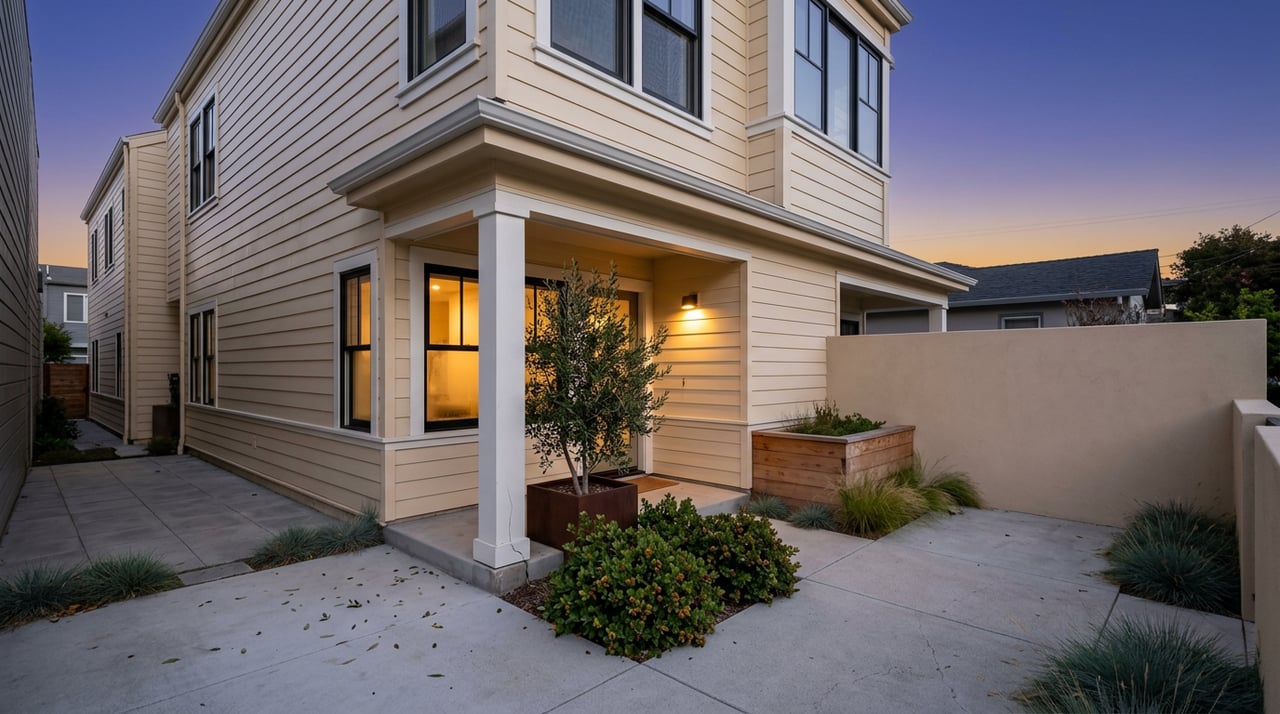
The West End's new construction, the townhomes and condos going up near Alameda Point and Alameda Landing, sold for more per house than the East End on average, but at $628 a square foot it ran well behind the Gold Coast's $849 and South Shore's $696. It also took longer to find a buyer, about 17 days on average, than the Gold Coast's 5 days, the East End's 13, or Harbor Bay Isle's 3. Buyers made roughly two offers per new-construction property, versus about three on East End listings.
If new construction were the obviously hot side of the market, you'd expect the opposite pattern: faster sales, tighter bidding, a premium per square foot for modern systems and floor plans. That's not what happened.
Why buyers are pricing new construction like it isn't scarce
The most likely explanation sits right in the infrastructure numbers above. Vintage Alameda, the Gold Coast estates, the East End Victorians and Craftsmans along Park Street and High Street, is fixed in supply forever. Nobody is building more of it. Buyers who want that specific inventory compete hard for what exists, which shows up as five-day sale cycles and $849 a square foot.
New construction at Alameda Point doesn't carry that same scarcity, at least not yet, and buyers appear to know it. They're aware more units are coming, even if they can't say exactly when. That knowledge takes some urgency out of the room. It's a rational response to a redevelopment that has been visibly, publicly slower than its own targets, the kind of thing a buyer notices after reading a single city council agenda.
The pipeline is real, and slower than the headlines suggest
The projects moving through approval right now are substantial, but they arrive in phases stretched across most of a decade, and not all of the units will compete in the open market:
- West Midway, a partnership between Catellus Development Corporation and Brookfield Properties, has approval for 478 market-rate condos, townhomes, and duets on 26 acres. A design review filed in 2025 covers a 284-unit first phase on 12.4 of those acres. Construction is planned in phases over roughly eight years, starting in the section bordered by Main Street, West Midway Avenue, West Tower Avenue, and Orion Street before expanding westward.
- RESHAP, built by MidPen Housing on 8 acres next to West Midway, will deliver 332 units of supportive and affordable housing. These units satisfy the city's affordability requirements for the district, but they won't show up as market-rate comparables for buyers or investors.
- Block 10, from Alameda Point Partners, is planned as 70 to 88 attached waterfront townhomes with an 18-minute ferry ride to downtown San Francisco.
- Island View and Waterside at Alameda Marina, built by Risewell Homes, add 98 townhomes and additional waterfront units in the 1,462 to 2,744 square foot range, some with rooftop decks.
Add that up and the total new supply is meaningful. But between deed restrictions on a third of it and an eight-year construction phasing that stretches well into the next decade, the flood of new inventory some buyers seem to be waiting on isn't arriving all at once. It's arriving in a trickle the city itself has struggled to fund on schedule.
What this means depending on why you're looking
If you're a seller with a Gold Coast or East End Victorian, the current data supports pricing with confidence. That inventory isn't being replaced, and the days-on-market numbers back it up.
If you're an investor evaluating West End new construction, the slower absorption isn't a red flag on the property. It reflects a market correctly pricing in a supply pipeline that's real but gradual, which is a different risk profile than a market that's simply cooling.
If you're a design-minded buyer choosing a side of the island, the honest framing is that new construction buys you larger floor plans and modern systems at a lower cost per square foot, while vintage stock buys you a finite, non-replicable piece of the island's history at a real premium. Neither is the wrong call. They're just different bets on what the next few years of Alameda Point's build-out actually deliver.
A few direct questions
Will Alameda Point's new construction eventually push prices down across the island? Nothing in the current infrastructure timeline suggests supply is arriving fast enough to do that in the near term. The financing gap the city disclosed in January 2026 is a bigger constraint on pace than buyer demand.
Is the West End's slower sale pace a sign of weaker demand? The ferry ridership numbers argue against that. It looks more like a market correctly anticipating that more comparable units are still coming, so buyers aren't rushing the ones available today.
Does the RESHAP affordable housing project affect market-rate comps nearby? Not directly. RESHAP's 332 units are deed-restricted for supportive and affordable housing and sit outside the market-rate comparable set, though they will add density and amenities to the immediate area.
Reading Alameda Point's build-out correctly means reading city council agendas alongside the sales data, not just one or the other. If you're weighing a Gold Coast Victorian against a West End townhome, or trying to time an investment around what's actually coming online versus what's still stuck in a financing gap, that's exactly the kind of groundwork East Bay Home Transitions does before a client ever writes an offer. Reach out and we'll walk the current pipeline with you, parcel by parcel.