Ask three sources what a home in Rockridge is worth this year and you will get three different neighborhoods. Bay Area MLS data put the median list price at $849,000 in April 2026, based on a total of five new listings that month. Redfin's three-month window ending in May 2026 showed a median sale price of $1.9 million for the same streets. Back in February, Redfin's own figures for Rockridge had shown $2.64 million.
None of those numbers is wrong. Redfin recorded just nine closed sales in Rockridge in May 2026, up from eight the year before, and only five new listings came onto the market in April 2026. With a pool that thin, one high-end Craftsman closing or one fixer-upper entering the mix can swing the median by hundreds of thousands of dollars before the next data pull. That volatility has always been part of pricing a home here. What changed on July 1, 2026, is that the housing stock generating those numbers is no longer guaranteed to stay the size it is today.
The premium was always a bet on scarcity
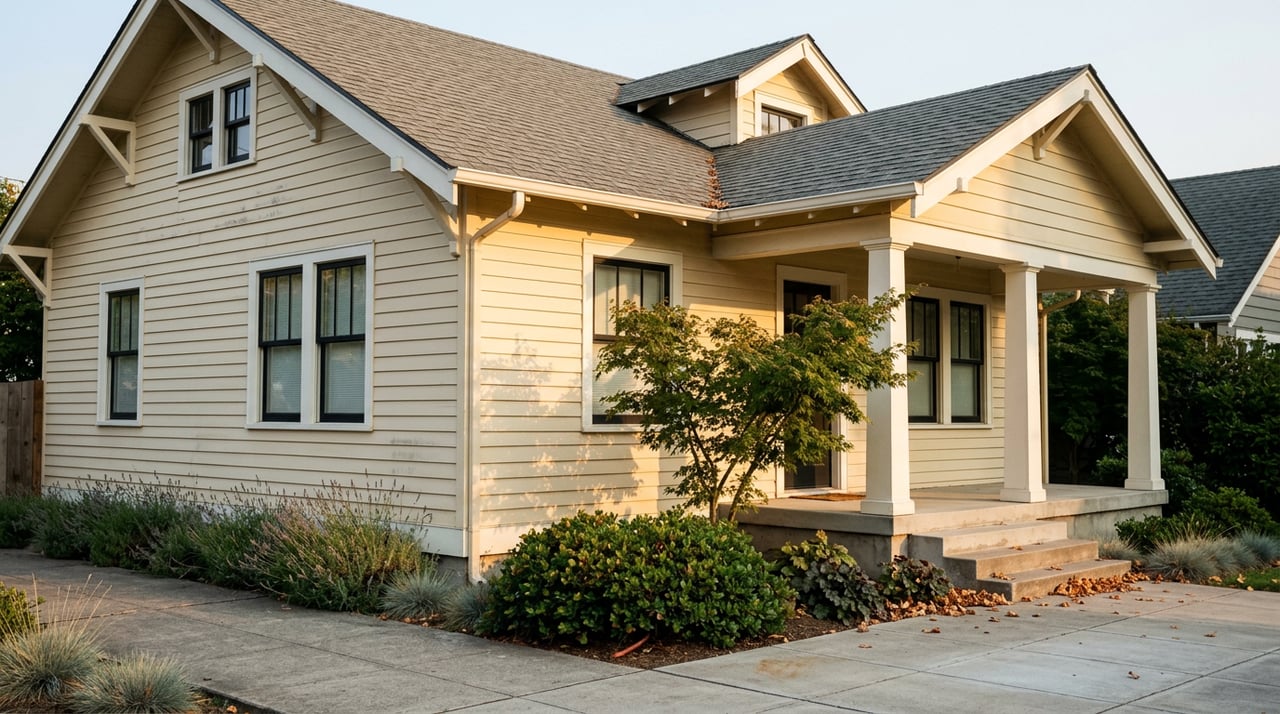
Rockridge's price tag has never really been about square footage. Buyers have been paying for a fixed, aging supply of Craftsman bungalows built mostly in the 1910s through the 1930s, sitting on a walkable strip anchored by College Avenue and a BART station that puts downtown San Francisco about 25 minutes away. That combination is rare in the East Bay, and rarity is what a premium is priced on.
A premium priced on scarcity only holds if the scarcity holds. That is the assumption a new state law just tested directly.
A law built to spend down that scarcity
Senate Bill 79, the Abundant and Affordable Homes Near Transit Act, took effect statewide on July 1, 2026, and it overrides local zoning near qualifying transit stations regardless of what a city council or neighborhood group would prefer. Rockridge BART is one of three stations in Oakland's District 1, alongside MacArthur and part of Ashby, and all three fall into SB 79's Tier 1 category, the classification carrying the largest allowable jumps in height and density. Near the Rockridge station, the law permits buildings up to 95 feet within 200 feet of the platform, 75 feet within a quarter mile, and 65 feet, roughly six stories, out to a half mile.
Cities can pause the law temporarily in areas the state has flagged as "low-resource," giving planners time to write a locally tailored alternative before the state standards kick in automatically. Oakland is doing exactly that in downtown, West Oakland and East Oakland. Rockridge, MacArthur and Ashby do not qualify. State mapping classifies them as "high-resource" or "high-opportunity," meaning residents already have strong access to jobs, schools and transit, and that classification is precisely what disqualifies the area from the delay everyone else gets.
Oakland's Planning Commission voted unanimously on February 4, 2026, to recommend a set of temporary exclusions for lower-cost transit areas, but commissioners including Natalie Sandoval and Alex Randolph specifically pushed to strip Rockridge, MacArthur and Ashby out of that protection, and the full Planning Commission recommendation reflects that split. Oakland City Council, on District 1 Councilmember Zac Unger's own amendment, confirmed the same approach on March 3, 2026. In his message to constituents explaining the vote, Unger put it plainly: it has long been city policy that new development belongs on the corridors rather than tucked into interior streets, and holding the corridors back under a temporary exclusion would have pushed density toward quiet residential blocks instead. The official city SB-79 page lays out the underlying framework for anyone who wants the ordinance language directly.
The Trader Joe's lot is the first test case
The clearest evidence of how this plays out on the ground sits on a 1.5-acre parcel at 5727 College Avenue, current home to the Rockridge Trader Joe's. On April 22, 2026, developer Align Real Estate filed an application to demolish the 20,000-square-foot store and its surface lot and replace it with two towers, one at 31 stories and 352 feet, the other at 25 stories and 294 feet, as first reported and confirmed by Oaklandside. The parcel's existing height limit is 95 feet, so the taller tower alone runs nearly four times what current zoning allows on that block.
The project would deliver 415 senior housing units: 371 independent living, 18 assisted living and 26 memory care. Because it's structured under the State Density Bonus Law's senior housing provision, none of those units are required to be income-restricted. The Trader Joe's would not reopen once construction begins, and the site carries its own labor history: it was the first Trader Joe's location in the country to unionize. The Rockridge Community Planning Council has publicly asked Align to preserve the store as, in the group's words, the neighborhood's only affordable grocery option and a foundational street-level use.
It isn't the only proposal in play. A separate developer wants to build an eight-story, 203-unit senior housing project at 6230 Claremont Avenue, the former Red Cross blood bank site, at nearly double the height the site's prior CN-1 zoning allowed. City staff declared that application complete on April 21, 2026. Neighbors organized around both projects: a Change.org petition against the Claremont proposal has collected more than 2,200 signatures, and a second petition, from a group calling itself Upper Broadway Advocates, is pushing developers to scale back what residents have started calling the two towers and keep Trader Joe's in place. A packed town hall at St. Augustine's Catholic Church on July 13, 2026, the third such meeting in two months, drew residents asking Unger and city staff whether anything could still be done. The coverage of that meeting captured Unger's answer: state law leaves the city very little room to say no.
One detail from that meeting is worth sitting with if you're trying to model where this market goes next. Unger described the entrance-fee model behind the proposed senior towers as requiring roughly $1 million to move in plus a monthly minimum near $10,000, with no ownership stake and no return of that entrance fee to a resident's heirs. That structure means most of these 415 units, if built, will never generate the kind of arm's-length resale transaction that feeds an MLS comp sheet the way a sold Craftsman does. The unit count in the neighborhood may rise. The pool of comparable sales data available to price the next listing on that block may not rise with it.
If you already own here
If you're a longtime Rockridge homeowner weighing whether to sell now or wait, there's a detail from the public comment period worth reading in full. One resident wrote to the paper covering these hearings that the developer frames the towers as a way to let seniors "age in place," and yet, as the letter put it, that's already what many residents over 60 are doing in the homes they already own. The irony is exact: the case being made for new supply targets a population that, in Rockridge, is largely already housed and already staying put.
For anyone in that position who does decide this is the window to sell, presentation and timing matter more than usual while the neighborhood's zoning story is still being written. Andrew Pitarre's team built East Bay Home Transitions around exactly this kind of transition, pairing Compass Concierge financing for pre-sale repairs with the in-house construction coordination to get a listing market-ready without a seller carrying the upfront cost.
If you're buying or holding for the long term
Oakland's own 2023 Housing Element already identified sites in and near Rockridge for 2,000 to 3,000 additional units, a 20 to 30 percent population increase concentrated along the Broadway, College, Claremont and Telegraph corridors plus underused parcels like the former California College of the Arts campus. That's the land-use argument for investors watching this neighborhood: value on the corridor parcels themselves is being repriced by state law right now, while the city's General Plan strategy is deliberately trying to keep interior residential blocks off Broadway Terrace and similar streets out of that same pressure. The neighborhood is starting to split into two value stories instead of one.
For buyers who want the classic version of Rockridge, the bungalow streets, the front porches, the human-scale block, the safer bet under the city's own stated strategy is a property set back from the corridor rather than facing it.
A few direct questions
Does this affect my house if it isn't near BART or College Avenue? Less than a corridor-facing parcel, based on the city's own stated approach, which is to push new density onto commercial streets specifically to shield interior blocks. The General Plan update carrying that strategy is expected to wrap up in 2027, so nothing about interior zoning is fully locked in yet.
Is the Rockridge Trader Joe's closing soon? Not immediately. Reporting from the Daily Californian in late April 2026 indicated the store is expected to stay open for several years while the project works through Oakland's multi-year entitlement and review process.
Is Rockridge the only Oakland neighborhood dealing with this? No, but it's in a small club. Oakland has dozens of BART and bus rapid transit stations subject to SB 79, and Rockridge, MacArthur and Ashby are the only three station areas the city chose not to shield with a temporary pause.
If you're weighing a sale, a purchase, or a long-term hold in Rockridge while this plays out, a conversation grounded in the actual filings and timelines beats a guess based on last month's median. Andrew Pitarre and the East Bay Home Transitions team track these Oakland and Berkeley zoning changes alongside the renovation and financing side of a sale. Start your transition with a free home valuation and renovation plan built around where this market is actually headed, not just where it's been.